Road closed sign on bridge
Concerned about flooding?
Check the latest flood warnings now

Case study

Coordinating property level surveys for climate resilience @ Rochdale

Context

The Flood and Coastal Resilience Innovation Programme (FCRIP) funded Resilient Roch project addresses local climate challenges (including flood risk) faced by residents in disadvantaged communities through the delivery of coordinated property surveys.

The target communities are penetrated by watercourses and host many properties at significant fluvial as well as surface water flood risk. This has heightened in recent years and is only set to increase with climate change and with ever greater pressures on the urban environment and its green and blue infrastructure.

Many households in the target communities are subject to multiple disadvantages impacting health, wellbeing, the environment, and living standards, often leaving people disproportionately vulnerable to flooding.

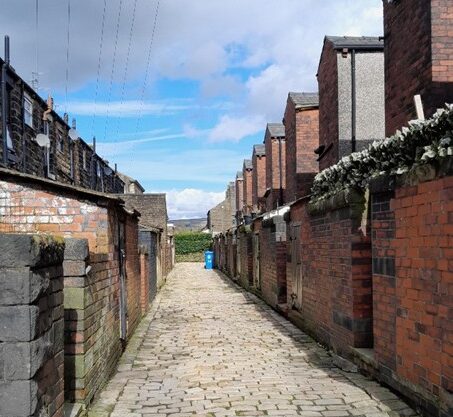
Like many post-industrial towns, Rochdale’s inner-urban housing stock is dominated by densely constructed late Victorian and Edwardian-era red-brick terracing, though there are some areas of more recently developed housing. Some of the housing is over a century old and in a poor state of repair. Typical features requiring repair or renewal include property roofing, pointing and remedial work to cellars that suffer from severe damp. In addition, and largely due to these characteristics, the energy efficiency of properties is often low, with some offered improvements through previous programmes, including Green Deal for Communities and previous iterations of the Energy Company Obligations (ECO).

The project team established partnerships to test a streamlined process for conducting multiple surveys simultaneously on private properties (Property Flood Resilience with ‘backyard’ Sustainable Drainage Systems (SuDS), property condition and energy efficiency).

This approach brought numerous benefits, including improved coordination, integrated interventions, and enhanced convenience and efficiency. There were also challenges, particularly regarding securing co-ordination and the need to develop a detailed knowledge base of properties and residents through thorough community engagement, which was supported by the National Flood Forum.

Contributor

Rochdale Borough Council

Learn more

Flood and Coastal Resilience Innovation Programme

Learn more

What was done

The surveys

The project aligned various funding streams and housing renewal objectives to maximise improvements in the housing stock. By addressing underlying issues that heighten residents’ vulnerability to flooding and fuel poverty, the surveys tackled key challenges faced by people in deprived areas.

Initially, three separate surveys were conducted for each property—assessing energy performance, structural condition (dilapidation), and PFR with backyard SuDS (see Figure 1). These were later consolidated into two surveys after overlapping elements and redundancies were streamlined.
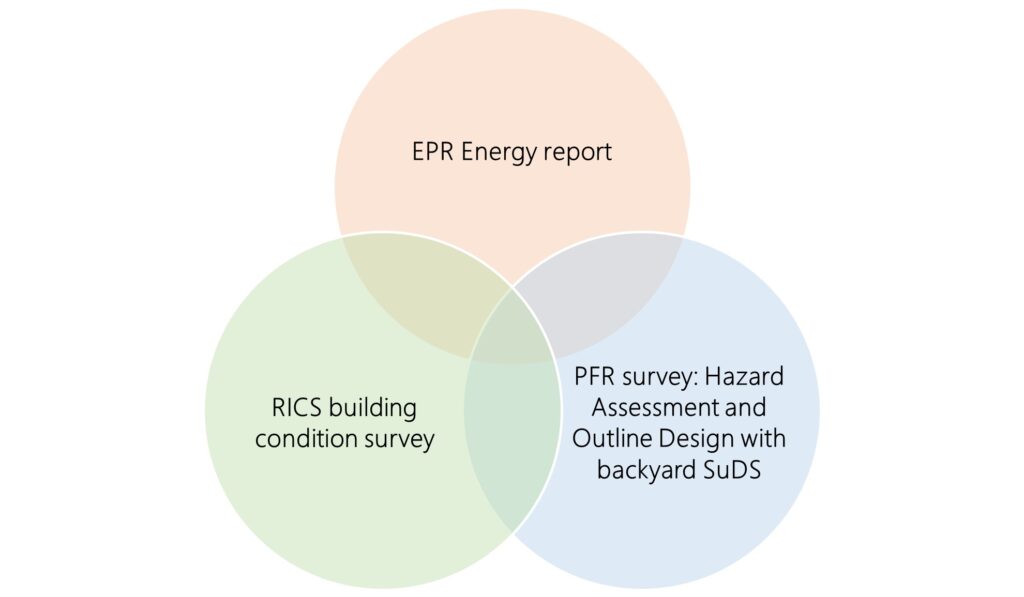
 

  • The RICS Building Condition survey highlighted any structural issues in the property requiring attention from the property owner. Vitally, this survey also identified if any building features – including maintenance and upkeep – would undermine the functionality of property level flood resilience and energy efficiency measures installed later. Any major issues affecting resident safety were reported to the Housing Service for further investigation.
  • The Energy Performance Report (EPR) gave the property an energy efficiency rating which partly determined the property’s eligibility for energy efficiency funding.
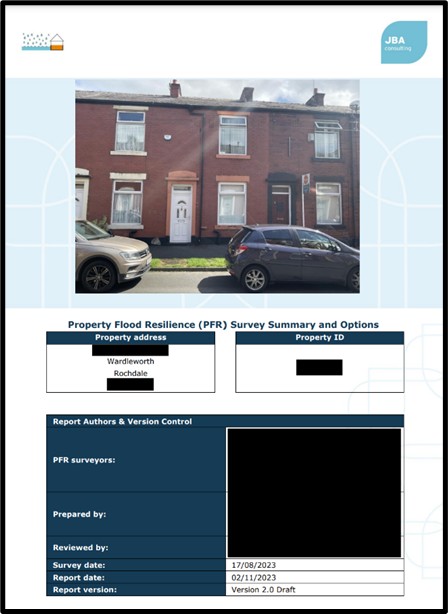
  • The PFR survey identified ingress routes into each property and listed suitable PFR interventions available, some of which would then be offered in the next stage of the project. The survey also assessed the suitability for incorporating backyard SuDSmeasures, to help manage stormwater locally (as close to its source as possible.


Combined survey approach for PFR
Figure 1 – Combined survey approach

Delivering multiple surveys over an extended period required strong coordination and communication. Many residents appreciated the convenience of joint visits, as it reduced their time commitment and disruption and improved their participation. Surveyors were able to coordinate and communicate interventions more effectively and identify critical safety issues; for example one property was deemed uninhabitable.

There where challenges with undertaking different survey types simultaneously, for example the duration of each survey type varied greatly which impacted on the programme’s wider delivery and funding schedule. Therefore, following a review of the initial survey pilot, some practical adjustments were made to the methodology to ensure that the surveys were completed as efficiently as possible. However, the need for two individual surveys caused confusion amongst some residents who did not realise that multiple surveys were required which initially increased administrative workload, but this challenge was overcome with improved communication to residents about the project which was explained when they initially expressed interest in the scheme through the council.

Rochdale Borough Council were the first point of contact for residents to sign-up to the project. The council team retained control of bookings for the energy efficiency and building condition surveys, whilst JBA Consulting booked PFR surveys with residents once the council had informed them who had signed up, demonstrating effective collaboration and communication between the project teams.

Clear project ‘Resilient Roch’ branding, along with consistent project contact details from Rochdale Borough Council ensured efficient communication which helped to minimise resident confusion and provide reassurance that contracts were legitimate.

The project produced co-benefits by encouraging cross-team collaboration and innovation and in housing strategy delivery. Completed reports were shared with residents and landlords.

Following the initial round of surveys and a review of their scope and content, the RICS survey was deemed optional for many properties, particularly where no clear structural issues were identified. The general PFR and EPR report, along with the subsequent Watertight fitting assessment, was typically sufficient to flag cases where a more detailed structural survey was necessary. If the RICS survey is no longer a baseline requirement, it’s important to avoid implying to others that it is always essential.


Other project information


The research was funded by the Flood and Coastal Resilience and Innovation Programme and has been produced in partnership with Rochdale Borough Council and the National Flood Forum. Delivery of this was only possible by working in partnership with JBA Consulting, Eclipse, Groundwork GM, Watertight and Rochdale Borough Council LLFA and Housing Team
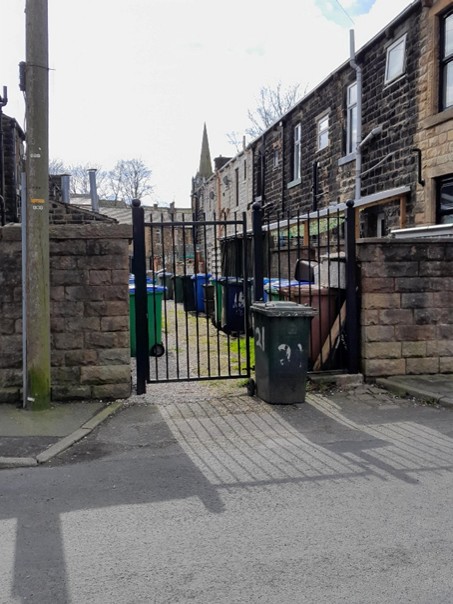
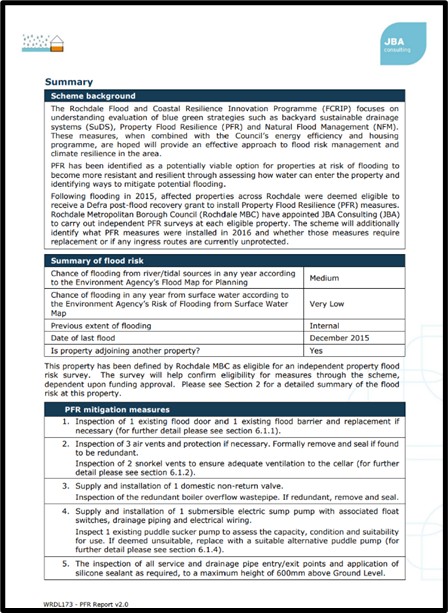
Partners: Rochdale Borough Council; Environment Agency Flood and Coastal Resilience and Innovation Programme; National Flood Forum; JBA Consulting; Watertight International; Eclipse Energy; Groundwork Greater Manchester
Type of flooding: Sewer/drainage, Surface water, River/fluvial
PFR process: General management and delivery, Preparation, Planning, Design, Operation/maintenance, Construction
Approach used: Resistance measures
Resistance PFR measure: Flood barriers/covers, Flood doors/windows, Flood gates, Self-closing airbricks, Air vent protection, Non-return valves, Cavity membrane/drainage system, Sump pumps, Sealing of walls, Re-pointing
Type of property: Residential
Funding: Public sector funding
Procurement: Public sector, EA PFR Framework, Local authority – other grant

What was the impact?

The surveys remained distinct but were conducted concurrently wherever possible. This allowed surveyors to co-ordinate their activity and would ensure that any installation to improve one aspect of the property would be complementary with other installed measures; for example it facilitated specification of more flood resilient alternatives for cavity wall insulation.

Communications were centralised within the core Resilient Roch team at RBC to provide a coherent identity to the work, to bolster residents’ confidence in the scheme and to provide them with a single point of contact for administrative or technical questions. This branding also helped provide integration with communications from the River Roch EA flood defence scheme, and the running of joint events such as informational drop-ins.

Completing the surveys concurrently encouraged early interaction between contractors and allowed some surveys to be completed at the same time on a property, making the process more convenient for the property occupier.

Lessons learnt

  • Benefits of combined surveys: Coordinating multiple surveys improved efficiency for residents, enabled better alignment of interventions, and uncovered serious safety issues. It also fostered cross-team collaboration and innovation within the council and delivery partners.
  • Challenges in delivery: Combined surveys posed logistical and communication challenges, with some contractors expressing concerns about overwhelming residents. Separating surveys after the pilot initially led to increased administration due to confusion amongst some residents regarding how many surveys were required. However, clear project branding and improved coordination and communication from the council during initial uptake helped to manage this and reduce the fear of the project being a scam amongst residents.
  • Tenant reluctance: Many tenants were hesitant to report poor housing due to fear of eviction and limited alternative housing options.
  • Safe reporting via surveys: Building condition surveys offered to landlords by Rochdale Borough Council (RBC) allowed issues to be identified without putting tenants at risk.
  • Critical safety findings: Surveys uncovered serious safety issues, including structural defects and a carbon monoxide leak. Whilst the carbon monoxide leak was in an owner occupier property RBC intervened to ensure landlord compliance and tenant safety where required.
  • Effective signposting: On-the-ground presence of RBC officers enabled referrals to other council services to address wider vulnerabilities and quality of life challenges. One elderly resident was supported in accessing a mobility-related home improvement grant. Another household was referred to funding that was used to replace their roof covering after the survey revealed deficiencies.
  • Survey intrusiveness: Energy and building condition surveys could be intrusive, involving multiple personnel and internal photography. Although every effort was made to minimise disturbance, this deterred some residents due to concerns including privacy.
  • Balancing trust and duty of care: Surveyors had to navigate tenant distrust while fulfilling their responsibility to report unsafe conditions.
  • Landlord engagement challenges: Gaining access to privately rented and HMO properties required consent from both landlords and tenants. Absentee or disinterested landlords posed significant barriers.
  • Uncovered hidden issues: The project revealed housing condition problems that may have otherwise remained unreported, leading to referrals to the council’s housing standards team.
  • Community influence: Trusted local groups (e.g., flood action groups) played a key role in building trust and encouraging participation.
  • Language and cultural barriers: Communication was slowed by language differences, especially in the diverse Wardleworth ward. Gender and cultural dynamics also affected access for surveys. Addressing these challenges required careful, sensitive administration on the part of scheme managers.
  • Funding constraints: Current grant funding criteria limit the integration of flood resilience, energy efficiency, and housing condition improvements. There is an opportunity for future grant schemes to accommodate more integrated ‘whole of society’ and ‘whole of property’ approaches to climate resilience. This will require cross departmental policy initiatives.
  • Integrated approach: Careful co-ordination enabled the project to address broader issues, including the importance of accessible, affordable, and appropriate insurance. In particular, site visits (and later, post-installation ‘handover’ meetings) were adapted to gather nuanced local insights into household insurance uptake. This was achieved through the inclusion of a brief series of targeted questions.
  • Future opportunities: The surveys have established a valuable evidence base to inform future interventions and research. The project is, for instance, exploring alternative funding sources to extend delivery beyond the current programme. The insurance-related data collected may also support the design of future innovations, for example, informing the development of Flood Performance Certificates by highlighting important social justice considerations.

Gallery

…from the beginning we’ve wanted to do it under the umbrella of the Council so that residents are reassured that it is a non-profit scheme, it’s not a scam, that it’s in keeping with the previous work that was done for the Storm Eva grant…We’re trying to project manage through us so that people are aware it’s one and the same project.” Delivery Manager, Resilient Roch

View more
case studies

Being prepared for potential flooding is an important element of being flood resilient as it leads to approaches to use PFR measures. It’s about understanding your flood risk, now and for the future.